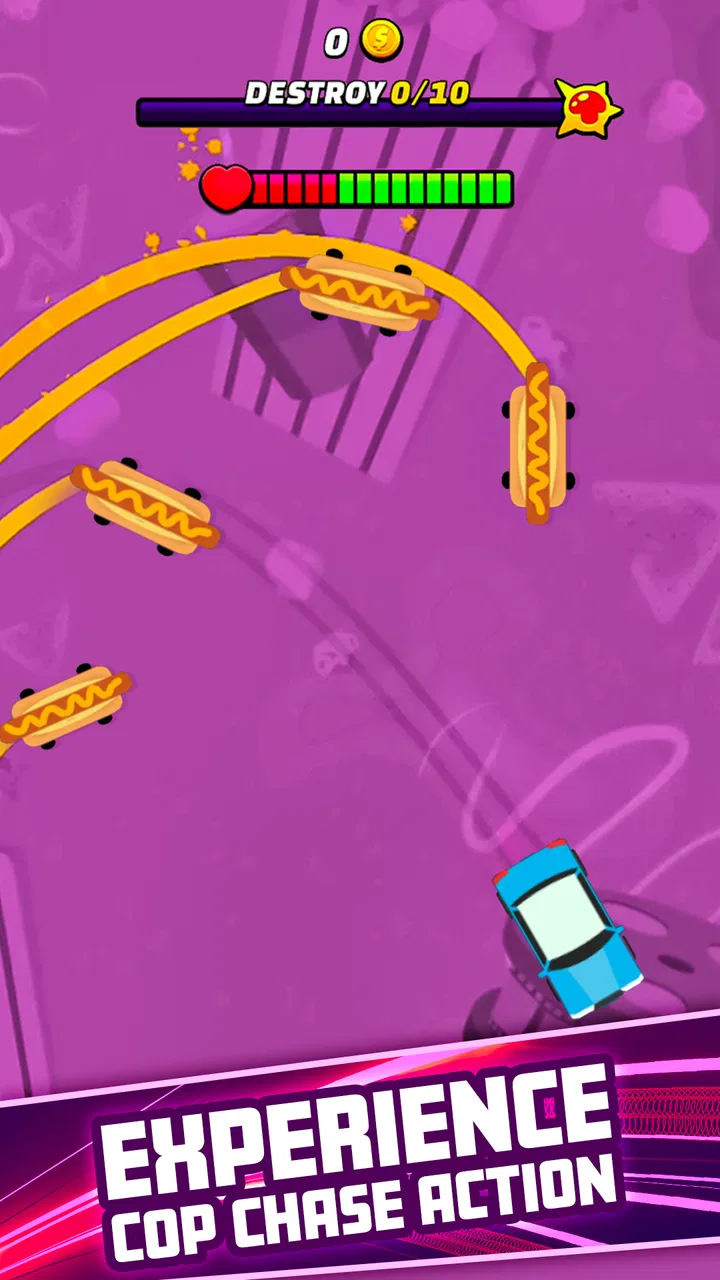
Police Pursuit: Burnout Rush!
- 4.6
- Rating
- 10.00M
- Installs
- Free
- Price

 Analysis by App-foxy
I spent time with Police Pursuit: Burnout Rush! as a quick-fire arcade game, and my first impression was clear: it is built for the moment when you want immediate action rather than a long tutorial, a complicated story, or a carefully planned campaign. The central appeal is the chase. You drive, react to police pressure, and try to keep the run alive while the situation becomes more demanding.
That focus makes it easy to understand within seconds, but it also defines the game’s limits. This is not the right choice if you are looking for a realistic driving simulator or a deep racing game with extensive vehicle management. It is much better suited to short sessions, quick retries, and players who enjoy improving through instinct and repetition. As a free arcade game from Kwalee Ltd, it is easy to try without committing money first, while optional purchases range from $1.99 to $3.99 per item.
What I considered before recommending it
I look at whether a chase game still feels worth opening once its first burst of novelty has passed, not just whether it makes a strong first impression. I’ll consider the habits it invites, the attention it asks for, and how to tell whether another run is genuine fun or simply routine. That helps frame the next question: what makes this particular pursuit worth trying in the first place?
You May Also Like

 Blood Strike: 2.5 Anniversary
Blood Strike’s Loadouts Turn Every Drop Into a Tactical Gamble
A close look at Blood Strike’s custom loadouts: how fast access to signature weapons reshapes its battle royale rhythm, rewards preparation, and narrows the gap between fights.

 Pandora - Music & Podcasts
Pandora’s Music Is Easy to Start, but Harder to Recover
Pandora’s strength is its low-effort path from a seed to a station. Its weak spot is how much confidence it asks you to place in connection, setup, and quiet recovery.

 8 Ball Pool
 Is Built on Rivalries, Rematches, and Routine
A close look at the rivalries, rematches, shared routines, and unanswered safety questions that turn a quick pool match into a persistent mobile community.

 Samsung Music
’s Quiet Strength Is Playing What You Already Own
Its reach comes less from spectacle than from dependable access to a personal library. That simplicity is both the app’s strongest retention engine and its ceiling.

 AccuWeather: Weather Radar
AccuWeather Review: A Quick, Clear Forecast for Everyday Decisions
For everyday plans, the best forecast is the one you can understand quickly. AccuWeather makes rain timing, radar, and local conditions easy to act on, with a few trade-offs.

 Hill Climb Racing
Why Hill Climb Racing Still Turns Crashes Into One More Run
A tiny car, a bumpy hill and one more upgrade: Hill Climb Racing keeps resurfacing because its simple chaos makes every near-miss feel personal.
More From Our News Desk



The kind of player who will enjoy the chase
I judge a game like this less by how much content it promises and more by how quickly it creates a satisfying decision. In this case, the important question is whether you enjoy driving under pressure. You need to watch the road, respond to pursuit, and accept that a small mistake can end a promising attempt. That loop works particularly well when I have only a few minutes and want something active immediately.
The game belongs firmly in the arcade category, and that matters. Arcade driving normally values responsiveness, spectacle, and replayability over strict realism. I found that expectation helpful because it stopped me from judging the experience by simulation standards. The fun comes from surviving the chase and learning how to handle the next attempt, not from recreating everyday traffic or professional racing.
It is also rated for Everyone, which makes it a relatively approachable choice for households looking for a straightforward driving game. That does not mean every player will enjoy it equally. Younger players may appreciate the simple objective, while experienced arcade fans may want more variety after repeated sessions. I would describe it as accessible at the controls but demanding in the way it asks you to stay alert.
Why short-session design matters here
My favorite way to use this game is as a break between other tasks. If I have a short wait, I can start a run without needing to remember a complicated plot or rebuild a strategy from a previous evening. The chase supplies the context immediately. That makes it a good fit for a phone, where a game often has to earn attention quickly.
A realistic everyday scenario would be a commute break or a few minutes before an appointment. I would play one attempt, notice where I lost control, and try again with a different line or a more cautious response. The value is not only in winning; it is in turning a failed run into a small lesson. If you prefer games that can be paused for long periods and resumed with no loss of concentration, this format is more convenient than a long race or story-driven adventure.
There is a trade-off, though. Short, repeatable sessions can feel refreshing at first and repetitive later. I would not install it expecting a game that becomes a daily narrative habit. I would install it because the core chase is easy to return to when I want a compact burst of pressure.
Controls, attention, and the real learning curve
The apparent simplicity of a pursuit game can be misleading. The basic idea is easy to grasp, but staying alive requires attention to timing and positioning. I found that the best improvement came from resisting the urge to react to every threat at the last possible instant. A calmer approach usually gives me more room to correct a mistake than frantic movements do.
One useful habit is to treat the first few attempts as observation rather than performance tests. I watch how quickly trouble develops, which turns feel safe, and where I tend to overcorrect. That approach is more effective than repeatedly playing with the sole goal of lasting longer. Once I understand my own mistakes, the chase feels less random and more like a pattern I can manage.
Another practical tip is to avoid playing while distracted. This is not a passive game that works well while half-watching a video or answering messages. The action may be simple, but the pressure comes from having to respond at the right moment. I get much more enjoyment when I give each run my full attention, even if the session itself is brief.
Where the game earns its popularity
The public response suggests that the concept has connected with a large audience: the game has an average rating of 4.6 from around 214 thousand ratings, with about 6.1 thousand written reviews. It has also passed 10 million installs. Those figures do not guarantee that it will suit everyone, but they do match my experience of a game that is easy to pick up and immediately understandable.
Its strongest advantage is the clarity of its purpose. I do not need to learn a large set of systems before the chase becomes interesting. The game puts its energy into pursuit, and that narrow focus helps it feel more direct than many mobile titles that introduce several unrelated mechanics before becoming enjoyable.
I also like that the pressure gives ordinary movement a reason. A turn is not just a turn when police are close behind; it becomes a choice between safety and speed. That tension is the part I remember after a session. The game does not need a complicated explanation to create it, because the chase itself supplies the motivation.
How it compares with other arcade driving choices
Compared with a traditional racing game, this is a more immediate and less formal experience. A racing title usually asks me to think about tracks, opponents, lap progress, vehicle setup, or finishing position. Here, the emotional center is escape and survival. If you want the satisfaction of mastering a circuit, another arcade racer may be a better match. If you want a quick situation that starts with pressure already present, this game has the stronger argument.
Compared with a driving simulator, the difference is even clearer. Simulators are for players who care about realistic handling, careful braking, and the details of operating a vehicle. I would not choose this game for that purpose. Its appeal is exaggerated action and responsive decision-making, not faithful recreation of driving.
Compared with endless-runner games, it shares the appeal of repetition and quick failure, but the chase gives the movement a more specific identity. An endless runner can feel like a test of reflexes along a fixed forward path. This game feels more like managing a pursuit, where the idea of being followed changes how I interpret each move. Players who enjoy endless runs but want a vehicle-centered setting may find that difference meaningful.
There is no universal winner among these categories. The right alternative depends on what I want from my phone at that moment. I choose this title for immediate pursuit tension, a racing game for competition around a course, and a simulator when realism matters more than instant excitement.
Friction points that affect the decision
The biggest limitation is the narrowness of the main idea. A strong chase can be compelling, but players who need constant novelty may eventually feel that the experience is circling the same basic appeal. I would be cautious about recommending it as someone’s only mobile game. It works better as a focused arcade option alongside games that offer different pacing or progression.
The free entry is helpful, but optional purchases are part of the experience, priced at $1.99 to $3.99 per item. I would start without spending anything and first decide whether the core loop holds my attention. That is especially important for a game built around repeated attempts: if the basic chase does not feel satisfying on its own, buying extras will not solve the underlying mismatch.
Another point is the difference between accessibility and depth. The game is approachable because its premise is obvious, but that does not automatically mean it offers the layered systems that long-term strategy players expect. Someone who enjoys building a garage, comparing detailed statistics, or planning a lengthy progression path may prefer a more management-heavy racing game.
I would also skip it if I dislike retry-based play. Failure is part of the structure, and the satisfaction comes from trying again with better judgement. Players who want a relaxed drive with no pressure may find the pursuit theme tiring rather than exciting.
Practical details before installing
The game is free to download and is listed for Android devices running version 7.0 or later. Its current version is 2.3.1. Those details make it a practical option for many users with older compatible phones, although the experience will still depend on how comfortable the device is with fast arcade action.
I recommend checking the purchase settings before handing the phone to a child, even though the content rating is Everyone. The age rating describes the suitability of the game’s content, while optional purchases are a separate consideration. For family use, I would make the payment decision in advance and let the player focus on the chase rather than unexpected spending choices.
The developer is Kwalee Ltd, a name associated here with a compact, accessible arcade experience rather than a simulation-first product. I see that as useful context when deciding what to expect. The game’s identity is not hidden behind a large collection of systems; it is built around getting into the action quickly.
When switching to another game makes sense
The cost of switching is low because this is a free game, so the main investment is your time and attention. If you try several sessions and still feel that the chase is repetitive, moving to a conventional racer is sensible. You may lose the immediate pursuit hook, but gain more structured competition and a clearer sense of course mastery.
If you are coming from an endless runner, the transition should feel familiar in one respect: quick attempts and learning through repetition. The adjustment is that the vehicle and police pursuit change the way you think about movement. I would give it a fair trial by playing several focused runs rather than judging it after one unlucky attempt.
If you are coming from a simulator, I would set expectations before installing. You are not switching to a lighter version of the same experience; you are changing priorities. You trade realism and detailed control for speed, immediacy, and a more dramatic arcade situation. That is a good trade only if those are the qualities you currently want.
Players who value offline-friendly, low-commitment entertainment may also appreciate the general shape of the experience, but I would not choose it solely because a game is easy to start. The chase must still feel enjoyable to you. My own test is simple: after a failed run, do I immediately see what I could try differently? If the answer is yes, the game has earned another session. If the answer is no, another category will probably serve me better.
My recommendation for different types of players
I recommend this game to anyone who wants a free arcade chase that can be understood quickly and played in short bursts. It is especially suitable for players who enjoy reflexes, pressure, and the small satisfaction of improving after a mistake. Its Everyone rating also makes it a reasonable candidate for a family device, provided purchases are handled deliberately.
I would recommend it less strongly to players who need a broad campaign, deep customization, realistic driving, or a large range of activities. The focused design is its strength and its weakness. It keeps the experience direct, but it may not provide enough variety for someone who expects a complete racing collection in one app.
My practical advice is to begin with a no-spend trial. Play when you can concentrate, use early attempts to understand your habits, and decide whether the pursuit itself remains fun after the first novelty fades. Do not measure it against a simulator if you want arcade excitement, and do not measure it against an endless runner if you need a completely different kind of rhythm.
After using it as a quick arcade break, I see Police Pursuit: Burnout Rush! as a focused recommendation rather than an all-purpose driving game. It succeeds when I want immediate action and a reason to try again, and it falls short when I want depth, realism, or a long-form progression system. For the right player, that focus is exactly the point: choose it for fast pursuit tension, not for a full racing simulation.
FAQs for Police Pursuit: Burnout Rush!
01What is the main objective of Police Pursuit: Burnout Rush!?
In Police Pursuit: Burnout Rush!, the main objective is to evade the police while navigating through high-speed chases. Players must skillfully maneuver their vehicles to avoid capture, using power-ups and strategic driving techniques. The game challenges players to outsmart law enforcement while collecting rewards and unlocking new vehicles.
02What features does Police Pursuit: Burnout Rush! offer to enhance gameplay?
Police Pursuit: Burnout Rush! offers various features to enhance gameplay, including multiple vehicle options, dynamic environments, and challenging levels. Players can customize their cars, utilize power-ups, and experience realistic physics. The game also includes leaderboards for competitive play and regular updates that introduce new content and challenges.
03Is Police Pursuit: Burnout Rush! available on both Android and iOS?
Yes, Police Pursuit: Burnout Rush! is available on both Android and iOS platforms. It can be downloaded from the Google Play Store for Android users and the Apple App Store for iOS users. The game offers a seamless experience across both platforms, ensuring all players can enjoy the fast-paced action.
04Are there in-app purchases in Police Pursuit: Burnout Rush!?
Police Pursuit: Burnout Rush! includes in-app purchases that allow players to enhance their gaming experience. These purchases can unlock new vehicles, skins, and additional features. While the core game is free to download, these optional purchases provide players with the opportunity to customize and progress more rapidly.
05What are the system requirements for Police Pursuit: Burnout Rush!?
For optimal performance, Police Pursuit: Burnout Rush! requires Android devices to be running Android 5.0 or higher and iOS devices to have iOS 10.0 or later. The game is designed to perform well on most modern smartphones, but having a device with a good processor and sufficient RAM will ensure smoother gameplay.
Pros
- Exciting high-speed chases every level.
- Intuitive controls for smooth gameplay.
- Diverse range of police vehicles.
- Stunning graphics and environments.
- Regular updates with new challenges.
Cons
- In-app purchases can be pricey.
- Occasional lag on older devices.
- Limited customization options.
- Ads can interrupt gameplay.
- Requires constant internet connection.

Police Pursuit: Burnout Rush!
Gallery